The parable of the sower is one of the most important teachings Jesus shared about spiritual growth, faith, and the condition of the human heart. Found in Matthew 13, Mark 4, and Luke 8, this parable explains why people respond differently to God’s Word and how spiritual fruit develops in a person’s life.
At the center of the story is a farmer scattering seed across different kinds of soil. While the image appears simple, Jesus uses it to reveal profound truths about spiritual maturity, personal transformation, and the obstacles that affect faith.
The parable teaches that spiritual growth depends largely on the condition of the heart receiving God’s truth.
The Parable of the Sower Explained
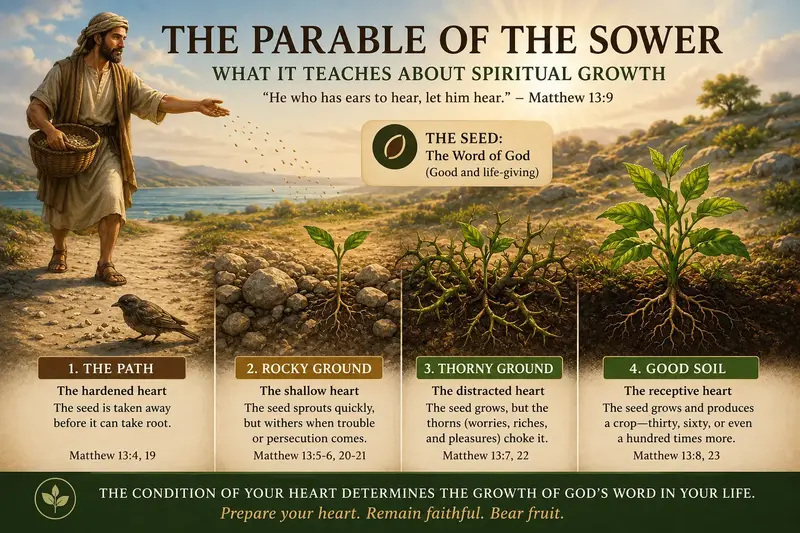
Jesus describes a sower who scatters seed across four types of ground:
- The path
- Rocky ground
- Thorny ground
- Good soil
Each surface produces a different outcome.
Some seeds never grow at all. Others begin growing but eventually die. Only the seeds planted in good soil mature and produce a fruitful harvest.
Jesus later explains that:
- The seed represents the Word of God
- The soils represent the condition of human hearts
This makes the parable deeply personal because it challenges every listener to examine how they respond to spiritual truth.
Why Jesus Used Farming Imagery
In ancient Israel, farming was familiar to nearly everyone listening to Jesus.
People understood:
- Planting
- Harvesting
- Soil conditions
- Weather challenges
- Crop growth
Jesus used these everyday experiences to communicate spiritual realities.
Just as healthy crops require good soil, spiritual growth requires a receptive and prepared heart.
The Seed Represents the Word of God
The seed symbolizes God’s Word, truth, and message of salvation.
The seed itself is always good.
The difference in growth does not come from the seed changing, but from the condition of the soil receiving it.
This teaches that spiritual growth depends not merely on hearing truth, but on how deeply it is received and nurtured.
The Four Types of Soil and Their Spiritual Meaning

Some seed falls on a path where the ground is hard and compacted. Birds quickly eat the seed before it can take root.
Jesus explains that this represents people who hear God’s Word but do not truly understand or receive it.
Their hearts are spiritually hardened.
Characteristics of the Path Soil
- Resistant to truth
- Spiritually closed
- Easily distracted
- Unwilling to receive God’s message
The birds symbolize spiritual opposition that removes the message before transformation can occur.
This part of the parable teaches that spiritual growth cannot happen where hearts remain closed and unreceptive.
Rocky Ground: Shallow Spiritual Commitment
Other seed falls on rocky soil. The plants sprout quickly but wither because they lack deep roots.
This represents people who initially respond positively to God’s Word but fall away when difficulties or persecution arise.
Characteristics of Rocky Soil
- Emotional but shallow faith
- Lack of spiritual depth
- Inconsistent commitment
- Weak endurance during hardship
These individuals may appear spiritually excited at first, but their faith lacks strong roots.
The parable teaches that spiritual growth requires depth, stability, and perseverance.
Thorny Ground: A Distracted Heart
Some seed grows among thorns. Although the plants begin growing, the thorns eventually choke them.
Jesus explains that the thorns represent:
- Worries
- Riches
- Pleasures
- Worldly distractions
These things compete with spiritual priorities and prevent mature growth.
Characteristics of Thorny Soil
- Divided attention
- Spiritual distraction
- Material obsession
- Anxiety and stress
The plant grows temporarily but never becomes fully fruitful.
This teaches that spiritual growth can be suffocated by constant distraction and misplaced priorities.
Good Soil: The Receptive and Fruitful Heart
Finally, some seed falls on good soil and produces an abundant harvest.
This represents people who hear God’s Word, understand it, apply it, and remain faithful over time.
Characteristics of Good Soil
- Receptive heart
- Spiritual humility
- Consistency
- Obedience
- Perseverance
- Growth and maturity
Good soil does not merely hear truth — it produces visible fruit through transformed living.
What Spiritual Fruit Looks Like
The fruitful harvest represents spiritual transformation and godly character.
Spiritual fruit includes:
- Love
- Patience
- Kindness
- Faithfulness
- Self-control
- Compassion
- Wisdom
- Obedience
True spiritual growth becomes visible in attitudes, decisions, relationships, and daily life.
The Importance of Spiritual Roots
One of the major lessons in the parable is the importance of deep roots.
Shallow faith collapses under pressure.
Deep spiritual roots develop through:
- Prayer
- Scripture study
- Worship
- Obedience
- Community
- Consistency
Roots determine stability during difficult seasons.
When challenges arise, spiritually rooted believers remain firm rather than falling away.
Spiritual Growth Requires Cultivation
Good soil does not happen accidentally.
Farmers prepare soil carefully before planting. Likewise, spiritual growth requires intentional cultivation of the heart.
This includes:
- Removing distractions
- Repenting from sin
- Seeking God sincerely
- Staying teachable
- Remaining spiritually disciplined
The parable teaches that spiritual maturity develops gradually through ongoing faithfulness.
The Danger of Worldly Distractions
The thorny soil especially reflects modern life.
Many people hear spiritual truth but become overwhelmed by:
- Financial pressure
- Career ambition
- Entertainment
- Social media
- Anxiety
- Materialism
These distractions slowly consume spiritual focus.
The parable warns that growth can be choked not only by evil things, but also by excessive focus on temporary concerns.
The Role of Perseverance in Spiritual Growth
Healthy spiritual growth requires endurance.
The good soil produces fruit because it remains steady over time.
The parable emphasizes:
- Patience
- Long-term faithfulness
- Spiritual consistency
- Endurance during trials
Fruit does not appear instantly.
Spiritual maturity develops gradually through continual dependence on God.
How the Parable Applies to Personal Life
The parable invites every person to examine the condition of their own heart.
Questions believers should ask include:
- Am I spiritually receptive?
- Have distractions weakened my faith?
- Are my spiritual roots deep?
- Am I producing spiritual fruit?
- What is preventing growth in my life?
The story becomes a mirror for spiritual self-examination.
The Role of God’s Word in Transformation
The seed carries life within itself.
Likewise, God’s Word possesses transformative power.
The parable teaches that Scripture:
- Changes hearts
- Produces faith
- Brings wisdom
- Strengthens believers
- Leads to spiritual maturity
However, the effectiveness of the seed depends on how people respond to it.
The Parable and the Kingdom of God
Jesus often used parables to explain the kingdom of heaven.
The parable of the sower reveals that the kingdom grows differently in different people.
Some reject it completely.
Others accept it temporarily.
Only those who receive the Word deeply and faithfully produce lasting spiritual fruit.
This explains why responses to the Gospel vary so dramatically.
Why the Parable Still Matters Today
The modern world creates constant spiritual distractions.
People struggle with:
- Noise
- Busyness
- Anxiety
- Digital overload
- Emotional exhaustion
The parable remains highly relevant because it addresses the ongoing battle for spiritual focus and growth.
It reminds believers that spiritual health depends on cultivating receptive hearts rather than merely hearing truth passively.
Practical Lessons from the Parable of the Sower
The parable offers several practical lessons for daily Christian living.
Protect Your Heart
Be careful what influences your thoughts and priorities.
Stay Spiritually Rooted
Develop strong habits of prayer, worship, and Bible study.
Remove Spiritual Distractions
Identify things choking spiritual growth.
Remain Consistent
Spiritual maturity requires perseverance over time.
Produce Fruit
Allow God’s Word to shape actions, character, and relationships.
The Encouragement Found in the Parable
Although some seeds fail to grow, the parable ultimately ends with hope and abundance.
The good soil produces an extraordinary harvest.
This reminds believers that genuine spiritual growth is possible through faithful response to God’s Word.
God desires transformed hearts that flourish spiritually and reflect His character.
Final Thoughts on the Parable of the Sower
The parable of the sower teaches that spiritual growth depends on the condition of the heart receiving God’s truth.
The same seed is scattered everywhere, but the results differ based on receptivity, depth, focus, and perseverance.
Jesus uses this story to reveal:
- Why some people reject truth
- Why some fall away
- Why others become spiritually distracted
- Why faithful believers produce lasting fruit
The parable ultimately calls every believer to become good soil — receptive, rooted, faithful, and fruitful.
When God’s Word is planted deeply in an open heart, spiritual growth becomes powerful, life-changing, and enduring.