Love stands at the center of the New Testament. From the teachings of Jesus Christ to the writings of the apostles, love is presented as one of the greatest spiritual forces shaping human relationships, faith, sacrifice, and devotion to God. Yet the English language uses only one word — “love” — to describe many different emotions and connections.
The Greek language used in the New Testament is far more precise. It identifies several distinct forms of love, each carrying its own meaning and purpose. Understanding these four types of love gives deeper insight into Scripture and reveals how God designed human relationships to function.
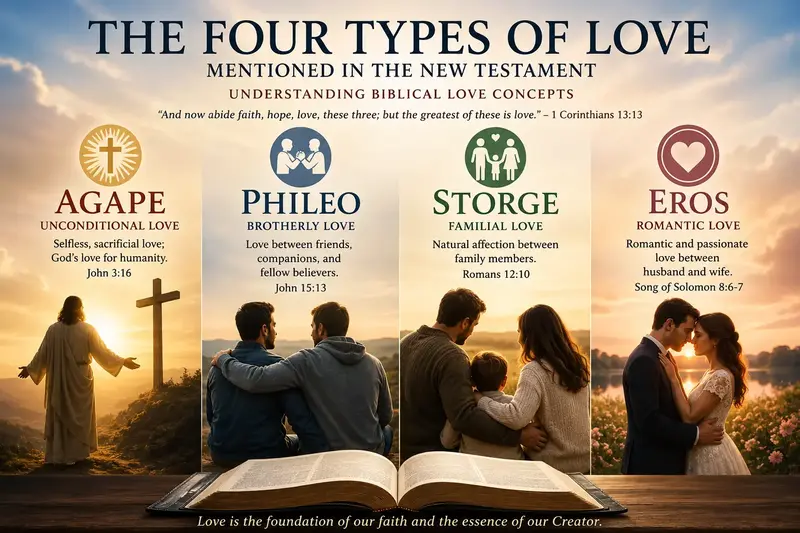
The four types of love commonly associated with the New Testament are:
- Agape
- Phileo
- Storge
- Eros
Each represents a unique expression of affection, loyalty, connection, and devotion.
Understanding Biblical Love in the New Testament
The New Testament was originally written in Greek, a language rich with emotional and philosophical nuance. Greek writers often used different words to distinguish between various forms of love rather than treating all affection as identical.
This distinction matters because biblical love is not merely emotional. It involves:
- Commitment
- Sacrifice
- Loyalty
- Compassion
- Spiritual maturity
- Relationship with God
The New Testament presents love as both a divine attribute and a human responsibility.
The Four Types of Love Explained

Agape is the highest and most powerful form of love mentioned in biblical teaching. It represents selfless, sacrificial, unconditional love that seeks the good of others regardless of circumstances.
This is the type of love most often associated with God.
Agape Reflects God’s Character
The New Testament repeatedly teaches that God’s love for humanity is agape love. It is not based on performance, worthiness, or emotional attraction. Instead, it flows from God’s nature itself.
One of the clearest examples appears in John 3:16:
“For God so loved the world, that he gave his only begotten Son.”
This love is sacrificial. God gave rather than merely felt affection.
Agape love:
- Forgives enemies
- Extends mercy
- Endures suffering
- Gives without expecting return
- Remains faithful
Agape Love in Daily Life
Believers are called to demonstrate agape love toward others.
This includes:
- Caring for people in need
- Showing patience during conflict
- Forgiving offenses
- Loving difficult individuals
- Sacrificing personal comfort for others
Agape love goes beyond emotion. It becomes visible through action.
Phileo Love: Friendship and Brotherly Affection
Phileo refers to friendship, companionship, loyalty, and mutual affection between people who deeply care for one another.
This form of love builds communities and strengthens emotional bonds.
The Meaning of Phileo
Phileo is often called “brotherly love.”
The city name Philadelphia literally means:
- “City of Brotherly Love”
Phileo love is rooted in:
- Trust
- Shared values
- Respect
- Loyalty
- Fellowship
Unlike agape, which is unconditional and sacrificial, phileo often develops through close relationship and shared experiences.
Friendship in the New Testament
Jesus demonstrated phileo love with His disciples. He spent time with them, taught them, encouraged them, and remained loyal to them even during hardship.
The New Testament encourages believers to:
- Support one another
- Encourage each other
- Build strong fellowship
- Live in unity
Healthy friendship reflects the warmth and relational depth of phileo love.
Storge Love: Family Affection and Natural Bonds
Storge refers to natural affection within families. It describes the emotional connection between:
- Parents and children
- Siblings
- Relatives
- Household members
This love often develops naturally through shared life and deep familiarity.
Why Storge Love Matters
Family relationships shape emotional growth, stability, identity, and trust. The New Testament values strong family bonds because families form the foundation of society and spiritual development.
Storge love is often expressed through:
- Protection
- Nurturing
- Caregiving
- Loyalty
- Long-term commitment
Family Relationships in Scripture
The New Testament teaches:
- Children should honor parents
- Parents should nurture children with wisdom
- Families should care for one another
- Believers should treat fellow Christians as spiritual family
Storge creates emotional security and belonging.
Eros Love: Romantic and Passionate Love
Eros refers to romantic attraction, passion, intimacy, and desire between partners.
Although the specific Greek word “eros” is not directly used in the New Testament text, the concept of romantic love clearly appears throughout Scripture, especially in discussions surrounding marriage and intimacy.
The Purpose of Romantic Love
Biblical romantic love is designed to:
- Unite husband and wife
- Strengthen marital bonds
- Encourage emotional intimacy
- Reflect covenant commitment
Healthy eros love combines:
- Passion
- Faithfulness
- Emotional connection
- Physical intimacy
- Mutual respect
Romance Within Marriage
The Bible consistently presents romantic love within the context of faithful commitment.
Romantic love without loyalty becomes unstable. Passion without wisdom becomes destructive. The New Testament emphasizes purity, faithfulness, and commitment alongside desire.
How Jesus Demonstrated Every Form of Love
Jesus Christ displayed multiple forms of love throughout His earthly ministry.
Agape Through Sacrifice
Jesus laid down His life for humanity.
Phileo Through Friendship
Jesus shared close relationships with His disciples.
Storge Through Family Care
Even while dying on the cross, Jesus showed concern for His mother.
Eros Through Biblical Marriage Imagery
The New Testament often compares Christ and the Church to a bridegroom and bride relationship, symbolizing covenant intimacy and devotion.
The Spiritual Importance of Love
Love is not treated as optional in the New Testament.
According to Scripture:
- Love fulfills the law
- Love reflects God
- Love reveals spiritual maturity
- Love strengthens the church
- Love transforms relationships
Without love, spiritual gifts and religious activity lose meaning.
The Famous Love Chapter: 1 Corinthians 13
One of the most recognized passages about love appears in 1 Corinthians 13.
This chapter describes the qualities of genuine love:
- Patient
- Kind
- Humble
- Forgiving
- Truthful
- Enduring
The chapter primarily describes agape love, showing believers how divine love should shape human behavior.
How the Four Types of Love Work Together
These four loves are not enemies competing against each other. Healthy relationships often include multiple forms of love simultaneously.
For example:
- A strong marriage may contain eros, phileo, and agape.
- A healthy family may include storge and agape.
- Christian fellowship often combines phileo and agape.
Together, they create balanced relationships rooted in care, loyalty, sacrifice, and trust.
Modern culture often reduces love to temporary emotion or attraction. The New Testament presents a much deeper vision.
Biblical love involves:
- Commitment over convenience
- Sacrifice over selfishness
- Loyalty over instability
- Compassion over pride
Understanding these four forms of love helps believers:
- Build stronger relationships
- Grow spiritually
- Love others more effectively
- Understand God’s character more clearly
Love as the Foundation of Christian Living
Jesus taught that the greatest commandments are:
- Love God
- Love your neighbor
Everything else flows from these commands.
The four types of biblical love help explain how those commands become visible in real life through friendship, family, sacrifice, romance, service, and devotion.
Final Thoughts on the Four Types of Love in the New Testament
The New Testament presents love as far more than emotion. It reveals love as the foundation of spiritual life, human relationships, and God’s interaction with humanity.
The four types of love — agape, phileo, storge, and eros — each reveal different dimensions of connection and care.
Together, they create a fuller picture of biblical love:
- Agape teaches sacrifice.
- Phileo teaches loyalty.
- Storge teaches family devotion.
- Eros teaches romantic intimacy.
Understanding these forms of love provides deeper insight into Scripture and offers practical wisdom for building stronger, healthier, and more meaningful relationships rooted in biblical truth.