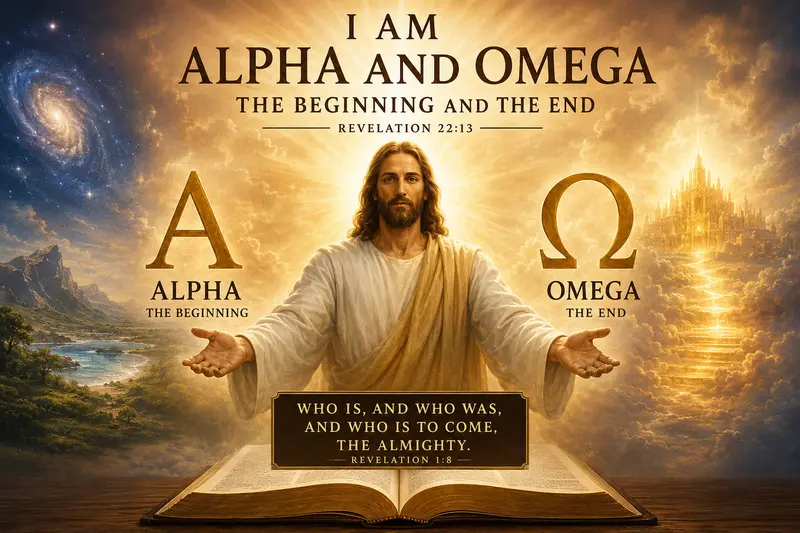
The title “Alpha and Omega” stands among the most powerful declarations found in the Bible. It appears in the book of Revelation as a majestic description of eternal authority, divine sovereignty, and absolute completeness. For centuries, readers have asked the same question: Who is the figure described as the Alpha and the Omega in Revelation?
The answer carries enormous theological weight because the phrase does not merely describe importance or greatness. It identifies the One who stands at the beginning and the end of all existence.
Understanding the Meaning of “Alpha and Omega”
The phrase comes directly from the Greek alphabet.
- Alpha = the first letter
- Omega = the last letter
Together, the expression symbolizes:
- The beginning and the end
- Eternal existence
- Supreme authority
- Completeness over all creation
- Dominion over history and eternity
In Revelation, the title points to One who transcends time itself.
The Key Revelation Verses About Alpha and Omega
Several passages in Revelation use this title directly.
Revelation 1:8
“I am Alpha and Omega, the beginning and the ending, saith the Lord… which is, and which was, and which is to come, the Almighty.”
This verse immediately establishes the figure as eternal and all-powerful.
Revelation 21:6
“I am Alpha and Omega, the beginning and the end.”
This declaration appears during the vision of the new heaven and new earth.
Revelation 22:13
“I am Alpha and Omega, the beginning and the end, the first and the last.”
This verse becomes especially significant because the surrounding context strongly identifies the speaker as Jesus Christ.
Is Jesus the Alpha and the Omega?
The overwhelming conclusion from Revelation is yes — the title refers to Jesus Christ.
The evidence appears throughout the text itself.
Revelation Connects the Title to Jesus Directly
In Revelation 22, the speaker says:
- “I am coming quickly”
- “My reward is with me”
- “I am Alpha and Omega”
These statements align directly with descriptions repeatedly used for Jesus throughout Revelation.
The chapter later states:
“I Jesus have sent mine angel to testify unto you these things in the churches.”
The flow of the passage leaves little ambiguity regarding the speaker.
Why the Title Matters Spiritually
Calling Jesus the Alpha and Omega means far more than saying He is important.
It means:
- Christ existed before creation
- Christ rules over history
- Christ remains sovereign over the future
- Christ possesses eternal nature
- Christ completes God’s redemption plan
The title places Jesus outside ordinary human limitations.
Alpha and Omega Compared With “First and Last”
Revelation also uses another related title:
- First and Last
These expressions work together.
| Title | Meaning |
|---|---|
| Alpha and Omega | Beginning and end of all things |
| First and Last | Eternal existence beyond time |
| Beginning and End | Source and fulfillment of creation |
Together, they form a complete picture of divine eternity.
The Old Testament Background Behind the Title
The idea did not begin in Revelation.
The Old Testament repeatedly describes God in similar terms.
Isaiah 44:6
“I am the first, and I am the last; and beside me there is no God.”
Isaiah 48:12
“I am he; I am the first, I also am the last.”
These passages become extremely important because Revelation applies identical language to Jesus Christ.
This is one reason many theologians view the Alpha and Omega title as a declaration of Christ’s divinity.
How Revelation Builds the Identity of Jesus
Revelation consistently presents Jesus using divine imagery.
Titles Given to Jesus in Revelation
- King of Kings
- Lord of Lords
- The Lamb
- Faithful Witness
- Word of God
- Firstborn from the dead
- Alpha and Omega
Each title adds another layer to Christ’s identity.
The Symbolism of Beginning and End
The phrase communicates several profound biblical truths.
Christ as the Beginning
Jesus is connected to creation itself.
The Gospel of John states:
“All things were made by him.”
This means Christ is not part of creation. He stands above it as Creator.
Christ as the End
Revelation also portrays Christ as the final judge, redeemer, and victorious King who completes history.
Everything begins in Him and concludes in Him.
Why Revelation Uses Greek Letters
The use of Alpha and Omega was highly significant to ancient readers.
Greek was the dominant language across much of the Roman Empire. Using the first and last letters created an immediate symbolic message:
- Totality
- Fullness
- Eternity
- Ultimate authority
It communicated that nothing exists outside the power of God.
The Connection Between Creation and Eternity
The Alpha and Omega title links two major biblical themes:
- Creation
- Eternal destiny
Revelation presents Jesus as Lord over both.
Creation
Christ stands at the origin of existence.
Eternity
Christ also governs the future kingdom, resurrection, judgment, and everlasting life.
Common Questions About Alpha and Omega
Does Alpha and Omega Refer Only to God the Father?
Some readers argue this point because Revelation 1:8 references “the Almighty.”
However, Revelation later applies the exact title to Jesus in unmistakable ways, especially in chapter 22.
Is Alpha and Omega a Symbol or Literal Title?
It functions as both.
- Symbolically, it represents eternal completeness.
- Literally, it serves as a divine title used in Scripture.
Why Is This Title Important in Christianity?
The title supports central Christian beliefs about Jesus:
- Eternal existence
- Divine authority
- Sovereignty over history
- Power over life and death
Key Themes Associated With Alpha and Omega
Eternity
Christ has no beginning and no ending.
Sovereignty
Nothing escapes His authority.
Redemption
The One who begins salvation also completes it.
Victory
Revelation ends with Christ triumphant over evil, death, and judgment.
Revelation’s Central Message About Christ
The book of Revelation is not merely about prophecy, disasters, or end-times symbolism.
At its core, Revelation reveals the supremacy of Jesus Christ.
The Alpha and Omega title becomes one of the clearest declarations of that truth.
It shows:
- Christ before history
- Christ within history
- Christ beyond history
Theological Importance of the Title
Throughout church history, theologians have viewed the Alpha and Omega declaration as evidence of Christ’s divine identity.
The title places Jesus in the same eternal framework used for God in Isaiah.
This connection became foundational in early Christian doctrine concerning the nature of Christ.
Final Answer: Who Is the Alpha and the Omega in Revelation?
The figure described as the Alpha and the Omega in Revelation is Jesus Christ.
The title identifies Him as:
- Eternal
- Divine
- Supreme over creation
- Sovereign over history
- Victorious at the end of the age
Revelation uses this phrase to reveal Christ as the One who stands at both the beginning and the end of all things — the eternal King whose authority never fades.